Battle of Grunwald 1410
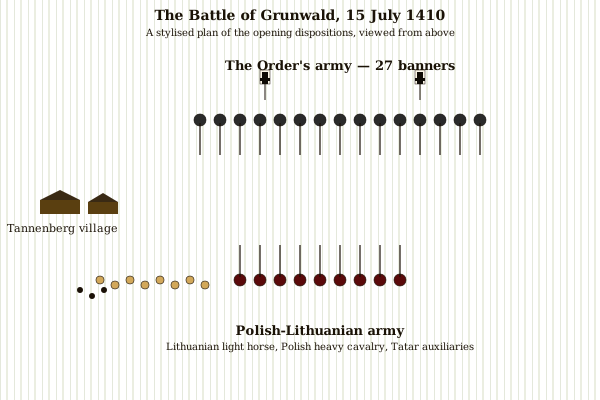
The battle of Grunwald, fought on 15 July 1410, is the most celebrated and the most consequential engagement in the history of the Teutonic Order. The battle pitted the army of the Polish-Lithuanian union — under King Władysław II Jagiełło of Poland and Grand Duke Vytautas of Lithuania — against the field army of the Teutonic Order under the Grand Master, Ulrich von Jungingen. The result was a catastrophe for the Order: the Grand Master, the Marshal, the Grand Hospitaller, and a great number of knight-brothers were killed, the great seal of the Order was lost, and the Order’s field army was effectively destroyed.
The Origins of the War
The war of 1409–1411 was the consequence of a long-running dispute between the Teutonic Order and the Polish-Lithuanian union over the control of Samogitia, a contested territory in the southern Baltic. The Samogitian revolt of 1409, supported by Vytautas, provided the spark for the war. The First Peace of Thorn, signed on 8 October 1409, provided a brief intermission, but both sides used it to prepare for a renewed campaign.
The campaign of 1410 opened, in late June, with a major Polish-Lithuanian invasion of the Order’s Prussian lands. The Order’s response was to concentrate its field army at Marienburg and to march, in early July, towards the Polish-Lithuanian lines. The two armies met, on 15 July, on the plain of Grunwald.
The Disposition of the Forces
The Polish-Lithuanian army was, by the standards of the age, a very large force. The Polish contingent comprised the feudal levies of the Polish crown lands and a substantial number of mercenaries. The Lithuanian contingent comprised the feudal levies of the Lithuanian grand duchy and a substantial number of Tatar auxiliaries. The total strength is unknown, but contemporary estimates suggest 30,000 to 40,000 men, of whom perhaps 15,000 to 20,000 were effective fighting men.
The Teutonic Order’s field army was, by contrast, substantially smaller. The Order’s principal strength was the knight-brothers, of whom perhaps 250 took the field at Grunwald. The Order’s army was, in addition, supported by a substantial number of secular knights, Turcopoles, mercenaries, and a number of crusaders. The total strength of the Order’s army has been variously estimated at 15,000 to 27,000 men.
The Polish-Lithuanian army was a heterogeneous force. The Lithuanian contingent, although smaller in numbers, was, in the military sense, the more formidable: the Lithuanian cavalry was a highly mobile and effective force, and the Tatar auxiliaries provided a substantial additional force. The Order’s army, by contrast, was a homogeneous force of considerable quality, with the knight-brothers being the most highly-trained heavy cavalry in northern Europe.
The Course of the Battle
The battle opened, on the morning of 15 July, with a series of skirmishes between the advanced guards. The Polish-Lithuanian army was, in the early stages, formed up in a defensive position. The Order’s army, by contrast, was formed up in a series of deep columns, with the knight-brothers in the vanguard.
The first major engagement was a Lithuanian attack on the Order’s right flank, which was repulsed with heavy loss. The Order’s commanders, having been informed by their scouts that the Lithuanian attack was a feint, decided to commit the main body to a major assault on the Polish-Lithuanian line. The assault was, in the early stages, successful: the Order’s knight-brothers broke through the Polish-Lithuanian left flank and engaged the Polish centre.
The turning point of the battle came in the early afternoon, when the Order’s assault was checked and the Polish-Lithuanian reserves were committed. The Polish cavalry struck the Order’s army in flank, and the Lithuanian cavalry, having rallied from its earlier repulse, joined in the general engagement. The Order’s army, attacked in flank, began to lose cohesion.
The final stage of the battle was a general rout. The Order’s knight-brothers, surrounded and cut off from the rest of the army, were cut down where they stood. The Grand Master, Ulrich von Jungingen, was killed, fighting to the end. The Marshal, Friedrich von Wallenrode, was killed. The Grand Hospitaller, Kuno von Lichtenhain, was killed. The great seal of the Order, which the Grand Master had been carrying on his person, was captured by the Polish-Lithuanian forces.
The Casualties and Consequences
The casualties of the battle were very heavy on both sides. Of the roughly 250 knight-brothers who took the field, only a handful — perhaps 15 to 20 — survived the day and the subsequent pursuit. The total casualties of the Order’s army have been estimated at 8,000 to 12,000 men. The Order’s losses included a substantial proportion of its most senior officers: the Grand Master, the Marshal, the Grand Hospitaller, the Grand Trapier, the Grand Komtur, the Landmeister of Prussia, and a number of regional commanders were all killed.
The battle of Grunwald was, in the short term, a serious military disaster. The Order’s principal fortress, Marienburg, was, in the days following the battle, besieged by the Polish-Lithuanian forces. The Order’s response was, however, remarkably effective. The Order’s remaining leadership, under Heinrich von Plauen, the Komtur of Schwetz (Świecie), succeeded in holding Marienburg against the Polish-Lithuanian siege, and the Order’s territorial integrity, in the short term, was preserved. The First Peace of Thorn, signed on 1 February 1411, brought a formal end to the war. The Order retained its principal territorial possessions, including Marienburg itself.
The battle of Grunwald was, a decisive event. The battle marked the end of the Order’s military ascendancy in the Baltic. The Order was, after 1410, a smaller and a less confident corporation than it had been before. The Order’s diplomatic position in the Empire was weakened. The Order’s ability to recruit knight-brothers from the German lands was permanently impaired. The Order’s long fifteenth-century decline, which was to culminate in the Thirteen Years’ War and the Second Peace of Thorn, had its beginning, in significant part, in the catastrophe of Grunwald.
Sources
- Biskup, Marian. Der Deutsche Orden im Zeitalter der Reformation. Marburg: Elwert, 1989.
- Biskup, Marian, and Gerard Labuda. Dzieje zakonu krzyżackiego w Prusach. Gdańsk: Wydawnictwo Morskie, 1986.
- Boockmann, Hartmut. Der Deutsche Orden: Zwölf Kapitel aus seiner Geschichte. Munich: Beck, 1981.
Related Reading
For the longer context of the Order’s decline, see the article on the decline and dissolution of the Order and the article on the 1525 dissolution in Prussia. For the parent context, see the History of the Teutonic Knights. The Prussian state that the Order lost, in part, at Grunwald is examined under the Teutonic state in Prussia. The principal fortress of the Order, Marienburg, is examined under the Order’s castles and architecture.